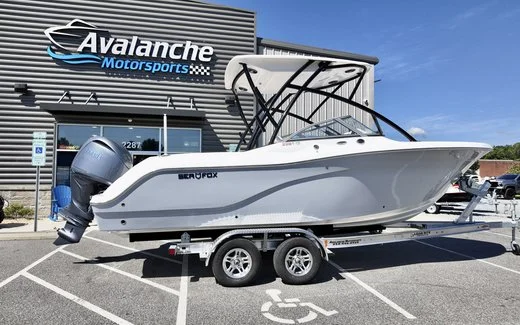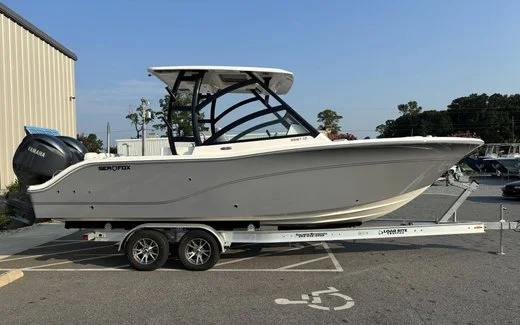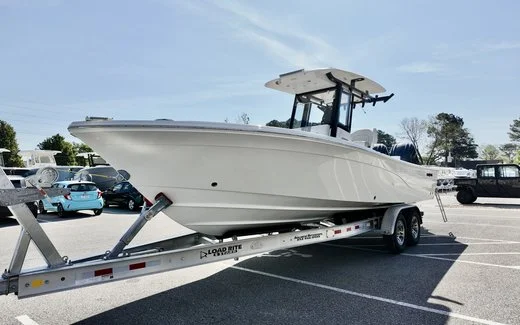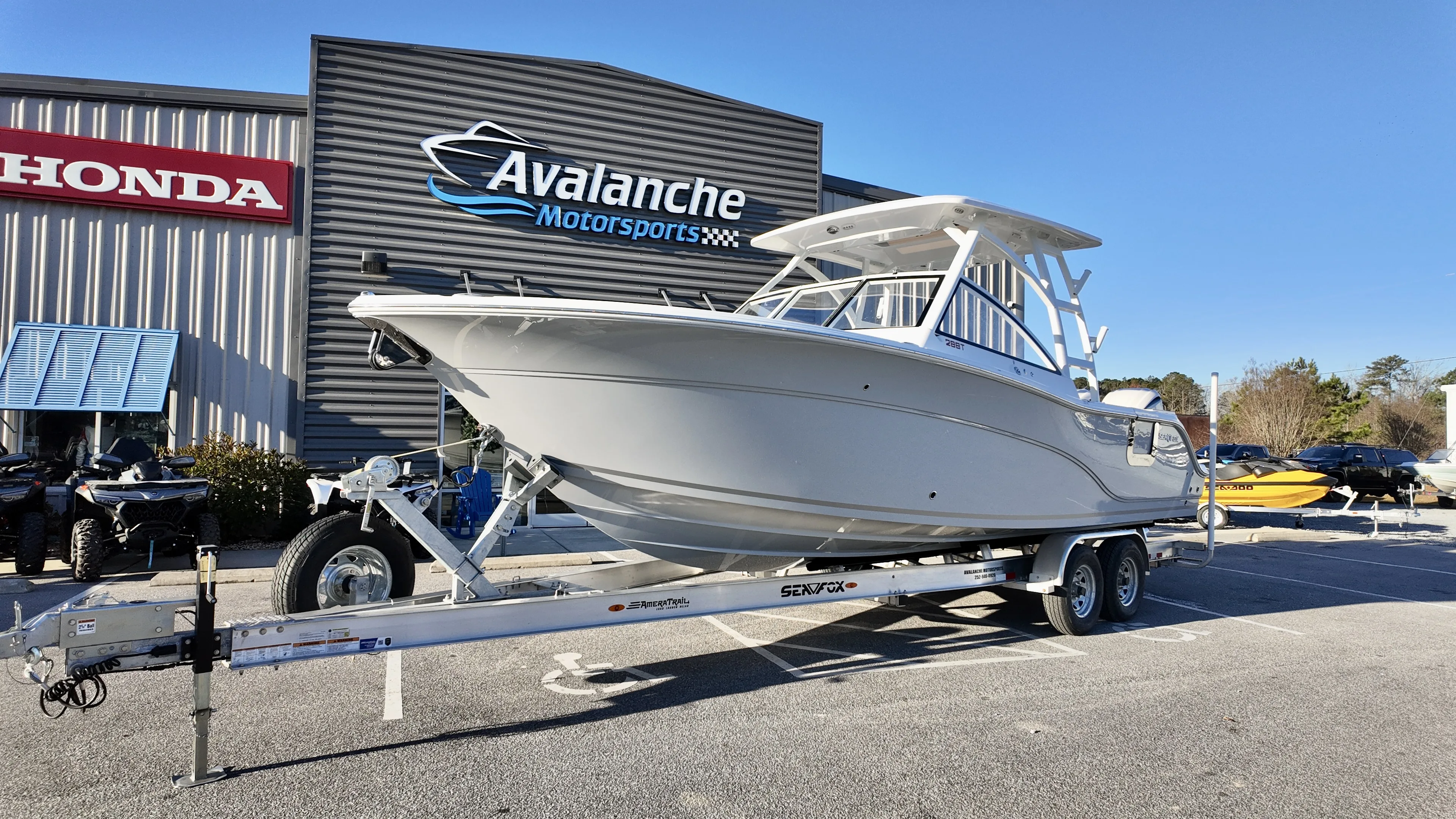
~$170,000 MSRP*Estimated MSRP
Sea Fox vs. Mako · Honest Comparison
Sea Fox 288 Traveler vs. Mako 334 CC
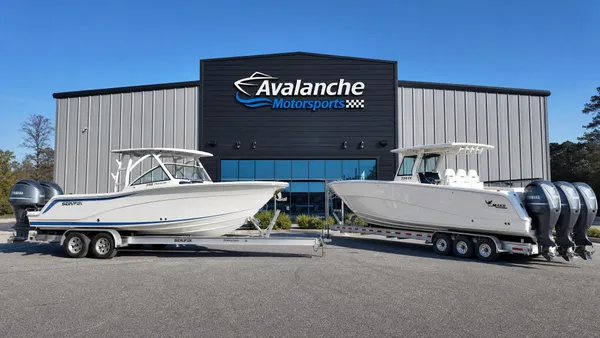
This page compares the Sea Fox 288 Traveler and Mako 334 CC side by side — specs, price, fuel range, livewell, hull design, and warranty — written by Avalanche Motorsports, the #1 Sea Fox dealer in North Carolina. Both boats are available for sea trial in Washington, NC.
The Mako 334 CC carries 280 gallons of fuel -- 127 more than the Sea Fox 288 Traveler's 153-gallon tank -- yet the Sea Fox costs $85,000 less at MSRP, rates 100 more horsepower, and drafts 6 inches shallower at 18 inches.
Quick Answer —The Mako 334 CC's 280-gallon tank gives it a genuine range advantage for Gulf Stream runs that the 288 Traveler's 153-gallon tank cannot match without a bladder or fuel stop. The Mako also carries Kevlar hull reinforcement and twin 28-gallon livewells with clear Plexiglass lids versus the Sea Fox's single 30-gallon unit. If you fish Pamlico Sound, the Neuse flats, or Core Sound -- where 18-inch draft lets you run skinny water the Mako's 24-inch draft cannot touch -- and you want 800 HP on a lifetime structural hull warranty with a 5-year blister guarantee, the 288 Traveler is the boat. If your season is built around 60-plus-mile offshore runs to the Gulf Stream for mahi and wahoo and you need fuel capacity to do it without stopping, the 334 CC earns its $15,000 premium.
Mako
334 CC
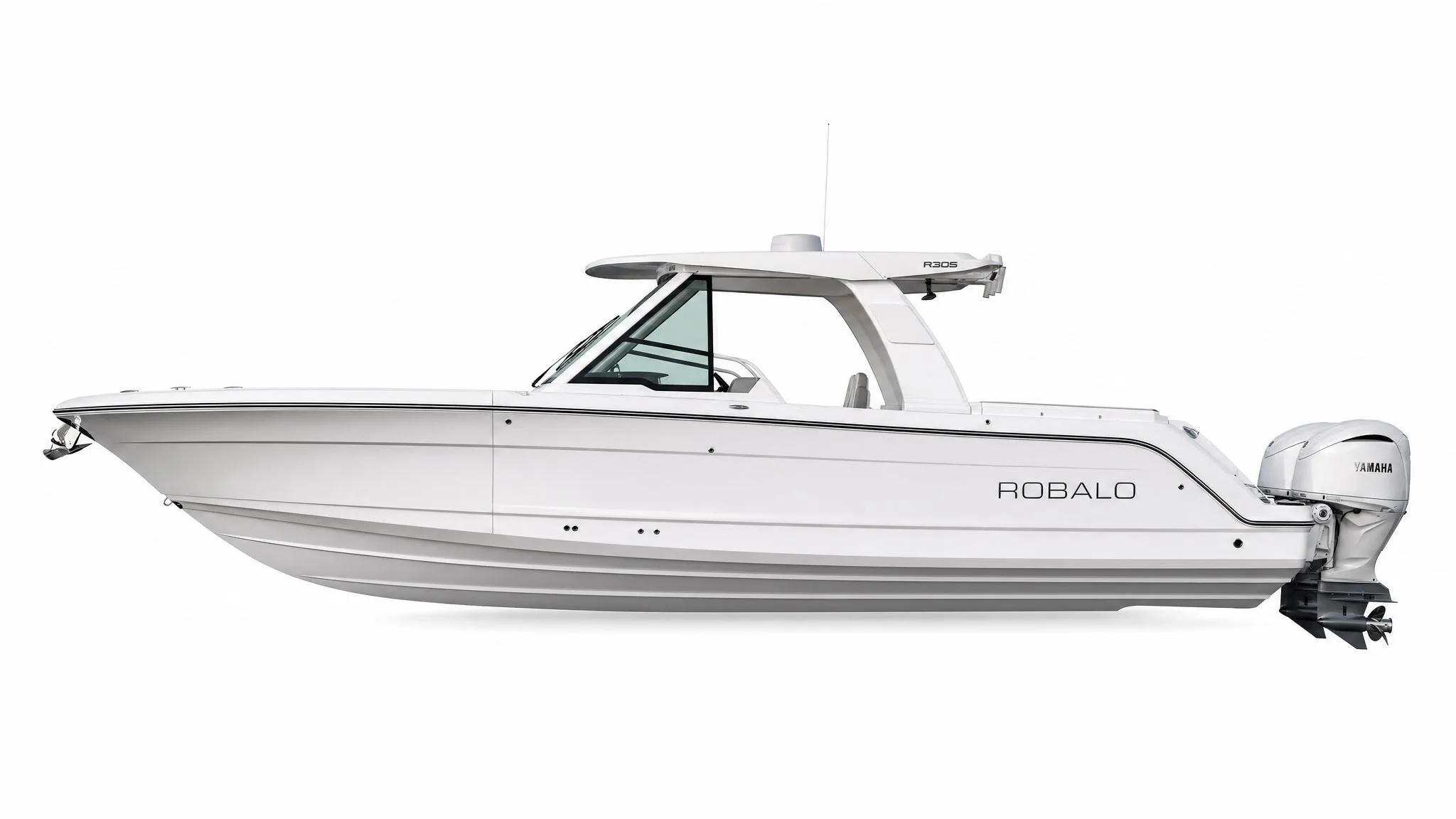
~$255,000 MSRP*Estimated MSRP
288 Traveler at a Glance

28'0"Length
9'8"Beam
14Capacity
153 galFuel Tank
600 HPMax Power
18°Deadrise
18"Draft
8,610 lbsDry Weight
~$1,718/moEst. Payment
POWER OPTIONS
- F300XSB
- F300XSB2
BOW
- Stainless steel bow eye with chafe plate
- Windlass anchoring system with controls at helm & bow
- Bow compartment with anchor roller chute, chafe plate, safety strap, rope storage and access
- 5-Strand rode (200') and chain (15') kit
- LED navigation lights
- Freshwater washdown outlet at bow
- Curved bow backrest cushions (aft-facing) with removable bottom cushions
- Deep bow seating with coaming box storage
- Stereo remote and phone chargers
- Under seat insulated storage & fishbox
- Casting deck with removable filler board
- Stainless steel recessed grab rail at bow
- In-floor storage with 5-gallon bucket
- Stainless steel table mount
- Removable filler board table with leg and dedicated storage
- Removable bow filler cushion
- Foldable wind dam
- Storage compartment with console wiring access
HELM
- Yamaha digital electric steering (DES)
- For Yamaha digital motors (XSB twin application): Multifunction instrumentation with tachometer, speedometer, volt, fuel, and fuel management functions - Display may vary with availability
- JL Audio source unit with USB adapter. Source unit may vary with availability.
- JL Audio custom sound system: two amplifiers, two 10-inch subwoofers, and six 7-inch speakers featuring sport grilles
- Lighted speakers with 1200 watts of sound
- Top mount compass on console
- Console dash shroud
- Black acrylic console display
- Garmin 8612XSV touchscreen
- Stainless steel steering wheel with turning knob
- Helm chair with adjustable seat and armrests
- 12-volt power point
- Console courtesy lights
- Integrated console footrests
- Lockable console head door
- Electric ceramic toilet with 12 gallon holding tank
- Freshwater sink with counter space
- Amenities storage cabinet in head
- Mirror with storage hooks
- DEKit marine flooring accents
- Ultima hard top:
- D-tubing with full glass windshield
- White powder coat top and windshield frame
- Four LED spreader lights
- Safety storage box
- Overhead LED lights (red, white, & blue power cycle)
- All around folding navigation-anchor light
- Four rod holders
- Reinforced mounting pad for radar and antenna installation
- Outrigger mounting brackets
- Fixed skylight
COCKPIT
- Stainless steel 12v refrigerator
- Back to back bench seating pod with deluxe bucket chairs with adjustable armrests
- Pull out aft facing lounge seat
- Galley with sink, stainless steel fresh water faucet, and counter space
- Electric grill
- Cooler storage with mechanical slide tray and kick latch
- Raw water washdown
- Insulated in floor fish boxes with diaphragm style pump
- Stainless steel compression latches
- Full cockpit coaming pads
- Multi-use storage drawer with first aid kit
- In-floor watersport storage with 5 gallon bucket
- Port side dock - dive - fish door with stainless steel frame and latch
- Cup holders
- Stainless steel rod holders
- U-Shaped fold down seating on starboard side
- Aft bench seat with removable cushions
- Self bailing cockpit with stainless steel grates
- Aquarium style pressurized livewell with window (30 gallons, 1100 GPH aerator)
- Dip net with integrated easy access storage
- Livewell light
- Pre-rigging for four batteries
- Trunk access to battery storage and pumphouse with gas shock assist
- Battery switches with removable tackle storage
- Four quick release fender deck mounts
- Marine fuel/water separating filters
TRANSOM
- Stainless steel transom savers
- Stainless steel rear boarding telescopic ladder with integrated boarding handle
- Stainless steel through bolted grab rail
- Recessed electric trim tabs with integrated hull design
- Stainless steel lifting points on port and starboard transom
BILGE
- (2) 1500 GPH bilge pumps with built in electronic float switches
- Thru-hull transducer (B150M chirp)
- Composite hull & deck
- Isothalic gelcoat
- Vinyl ester barrier coat
- Sand-grip deck surface
- Stainless steel rub rail
- Stainless steel fasteners
- Stainless steel through hulls
- Stainless steel pull-up cleats
- Silver boot stripe available on white and full hull gelcoat options
- Limited Lifetime Hull Warranty
PowerYamaha 600 HP(2×)F225 · (2×)F250 · (2×)F300 max 600 HP
288 Traveler Details on SeaFoxBoats.com →

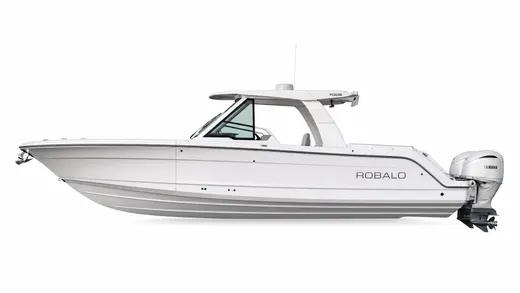
334 CC at a Glance
30'6"Length
10'6"Beam
Yacht CertifiedCapacity
280 galFuel Tank
700 HPMax Power
21°Deadrise
24"Draft
9,900 lbsDry Weight
~$1,825/moEst. Payment
OTHER
- Hand-laid deep-V hull with 24-degree deadrise and notched transom
- Mercury Joystick Piloting for Outboards standard
- Full head compartment with stainless sink and pump-out toilet
- 38-gallon freshwater tank
- Recessed auto-glide trim tabs
- Three-step dive ladder with tuna/dive door to port
- Freshwater and raw water washdown systems
- Non-skid deck surfaces
- Stainless hardware throughout
- Self-bailing cockpit with transom door
- Lifetime structural hull warranty
ELECTRONICS
- Garmin 7612 XSV dual chartplotters with 4G radar and dual-frequency sonar
- Fusion stereo with marine-grade lighted speakers and 1600W subwoofer
FISHING
- Two 34-gallon insulated aft livewells
- Two 290-qt insulated in-deck fishboxes with Gulper macerators
SEATING
- Tackle prep station on leaning post with sink chum bucket and tool racks
TOPS
- Hardtop with spreader lights and six rocket-launcher rod holders
- 16 rod holders in caprail plus six in hardtop
ELECTRICAL
- LED navigation and interior lighting
- Shore power inlet with battery management
PowerYamaha 700 HP max
Sea Fox 288 Traveler wins on price, warranty, and dealer support
Sea Fox 288 Traveler is backed by a Lifetime structural hull warranty and available from Avalanche Motorsports -- the #1 Sea Fox dealer in the USA. Call (252) 946-0920 to compare the Sea Fox 288 Traveler and Mako 334 CC side by side.
Key Takeaways
Purchase Price: $15,000 Separates These TwoSea Fox Wins
The Sea Fox 288 Traveler starts at $170,000. The Mako 334 CC starts at $255,000. That $15,000 stays in your pocket on day one -- enough to cover a full Garmin electronics package or two seasons of fuel.
Mako's 280-Gallon Tank Runs Farther OffshoreMako Wins
The Mako 334 CC carries 280 gallons versus the Sea Fox 288 Traveler's 153 gallons -- a 127-gallon advantage. A Gulf Stream run from Beaufort Inlet is roughly 120 miles round-trip; the Mako gets there and back with fuel to spare where the 288 Traveler needs a careful eye on the gauge. If you run the Stream regularly, that tank matters.
Sea Fox Drafts 6 Inches Shallower for NC InletsSea Fox Wins
The 288 Traveler drafts 18 inches. The Mako 334 CC drafts 24 inches. Six inches is the difference between running the back side of Core Sound at low tide and waiting for water. On Pamlico Sound's shoaling inlets and Harkers Island flats, the Sea Fox gets in and out where the Mako anchors up.
Mako's 21° Deadrise Cuts Steeper Offshore ChopMako Wins
The Mako 334 CC runs a 21-degree transom deadrise versus the Sea Fox 288 Traveler's 18-degree transom measurement. In a 4-foot quartering sea off Oregon Inlet, that extra 3 degrees softens the entry. The Sea Fox Carolina Flare hull varies from 18 degrees at the transom to deeper forward sections, which handles Pamlico Sound's 2-foot standing chop well -- but the Mako's hull geometry is purpose-built for sustained offshore running.
Sea Fox Warranty Covers the Hull for LifeSea Fox Wins
Sea Fox backs the 288 Traveler with a lifetime limited structural hull warranty for the original owner, a 10-year transferable hull warranty (one-time transfer), and a 5-year blister warranty. Mako offers a limited lifetime hull warranty with fewer published specifics on blister and transfer terms. The Sea Fox blister coverage alone -- 5 years prorated with a barrier coat requirement -- is a documented commitment Mako does not match in writing.
Bottom Line: 288 Traveler for NC Inshore-to-Nearshore BuyersSea Fox Wins
The Sea Fox 288 Traveler is $85,000 less, drafts 6 inches shallower, carries 800 HP max, and is backed by a lifetime structural hull warranty with 5-year blister coverage. The Mako 334 CC wins on fuel capacity and offshore deadrise -- it's the right call if you run the Gulf Stream more than twice a month. For the buyer who fishes Pamlico Sound, the Neuse flats, and makes occasional nearshore mahi runs, the 288 Traveler does the job for less money with better warranty documentation.
Why Buyers Cross-Shop These Boats
A crabber from Belhaven came in last spring ready to write a check for the Mako 334 CC. His reasoning was straightforward: 280 gallons of fuel versus the Sea Fox 288 Traveler's 153 gallons. He runs Spanish mackerel out past the Pamlico Sound fetch and occasionally pushes to the nearshore wrecks off Cape Lookout -- range mattered to him. On paper, the Mako won that column by 127 gallons.
Then he stood in both cockpits. The Mako drafts 24 inches. The 288 Traveler drafts 18 inches. Six inches sounds minor until you're trying to reach the drum holes on the backside of Ocracoke at low water. He also knocked on the Sea Fox transom -- 2-inch Penske composite board, zero wood -- then asked what was inside the Mako's transom. Mako's website doesn't say. That non-answer bothered him more than the fuel gap. He left with the 288 Traveler, $15,000 still in his pocket, and a lifetime structural hull warranty the Mako couldn't match.
Sea Fox vs. Mako: Price and Value
As the #1 Sea Fox dealer in the USA, we have this conversation every week. Here is what the numbers show.
Mako · starts at ~$255,000
334 CC
Starting at ~$255,000 depending on engine selection and options. A fully rigged, sea-ready 334 CC with electronics, outboards, and trailer will land most buyers above this figure.
Sea Fox · starts at ~$170,000
288 Traveler
Starting at ~$170,000 ° $85,000 less than the 334 CC at ~$255,000. Even rigged comparably, Sea Fox delivers more for less here.
I.127 Extra Gallons of Fuel
The Mako 334 CC carries 280 gallons versus the Sea Fox's 153 -- that extra 127 gallons is the difference between a single-tank Gulf Stream run and turning back early. If your season includes regular 60-mile-plus offshore trips past Oregon Inlet, this is a real operational advantage.
II.Twin 28-Gallon Insulated Livewells
The Mako runs twin 28-gallon livewells with LED lighting and clear Plexiglass lids -- purpose-built for keeping Spanish mackerel and red drum alive on long runs back from Core Sound. The Sea Fox 288 Traveler carries a single 30-gallon pressurized livewell, which covers most inshore trips but not a two-species tournament day.
III.Kevlar-Reinforced Hull + 70-Gallon Fish Box
The Mako 334 CC adds Kevlar reinforcement to its fiberglass hull and ships a 70-gallon aft cockpit fish box plus two 25-gallon bow fish boxes -- 120 gallons of fish storage total. The Sea Fox 288 Traveler's fish box specs are not published at the same level, so anglers targeting mahi and wahoo on multi-day trips should verify storage capacity before deciding.
Why Sea Fox Wins
The $15,000 Mako premium buys 127 additional gallons of fuel capacity and twin 28-gallon insulated livewells with LED lighting and clear Plexiglass lids -- it does not buy a deeper draft advantage (Mako drafts 24" versus Sea Fox's 18"), more horsepower, or a published blister warranty.
Run the Numbers Yourself
Adjust the prices, down payment, rate, and term to see what the gap actually costs you every month.
288T-
Mako 334 CC-
Monthly Difference-
Total Difference Over 20 years-
Estimates for comparison only, before tax, title, registration, and fees. Not a financing offer or quote - rates and terms depend on credit approval. Call (252) 946-0920 for current offers.
Build Quality: Sea Fox vs. Mako
The 288 Traveler and the 334 CC are both fiberglass center consoles, but how they're built determines what happens after 300 days of saltwater exposure and 90°F summer mooring temps in Pamlico Sound. The specific materials in the transom, deck core, and resin system are what separate a 10-year boat from a 20-year boat. Those details are not equal here.
Both all-compositeZero woodSF: Lifetime hull warranty
Mako
Full fiberglass structural system, Kevlar reinforced hull, poured composite transom coring, MPYD hull design Construction
The Mako 334 CC uses open-mold hand-laid fiberglass for the hull and deck -- a proven method -- with closed cavity bag molding (vacuum bag) for consoles and compartment lids, which does produce a cleaner, gelcoated interior surface on those components. The 334 CC spec sheet notes Kevlar reinforcement in the hull and a poured composite transom coring, which are genuine structural advantages worth acknowledging. However, Mako does not publish its resin type on makoboats.com -- polyester vs. vinyl ester is an unresolved question -- and Mako makes no wood-free claim anywhere on their website, meaning the presence or absence of wood in the deck or stringer system is not confirmed by the manufacturer.
Sea Fox
How Sea Fox Builds the 288 Traveler Hull
Sea Fox uses isothalic gelcoat from CCP -- a high-flex formula with superior osmotic blister resistance compared to standard polyester gelcoat -- backed by a 5-year blister warranty with a $80/ft cap. The transom is a 2-inch Penske composite board: no wood, no rot, impervious to water absorption even after years of outboard bracket stress. The deck core is Kledgecell closed-cell PVC -- it does not absorb water even if the surface is punctured, which matters when you're running 60 mph across the Neuse flats and a rod holder mount works loose. Foam-filled composite stringers are fiberglassed directly to the hull, creating one unified structure with no mechanical fasteners to corrode or loosen.
Side-by-Side Specs: 288 Traveler vs. 334 CC
→ Swipe table to see full comparison
| Spec | Sea Fox 288 Traveler | Mako 334 CC |
|---|---|---|
| LOA | 28'0" | 30'6" |
| Beam | 9'8" | 10'6" |
| Deadrise | 18° | 21° |
| Fuel Capacity | 153 gal | 280 gal |
| Max HP | 600 HP | 700 HP |
| Draft | 18" | 24" |
| Dry Weight | 8,610 lbs | 9,900 lbs |
| Person Capacity | 14 | Yacht Certified |
| Livewell | 30 gal | Twin 28-gal insulated livewells with LED lighting and clear Plexiglass lids |
| Hull Warranty | Lifetime structural hull | Limited lifetime hull |
| MSRP (Starting) | $170,000 | $255,000 |
| Price Difference | ~$85,000 less than Mako 334 CC | — |
| Monthly Payment (~240 mo) | ~$1,718/mo | ~$1,825/mo |
Interested in a Sea Fox? Get a Quote on the Sea Fox 288 Traveler
Call (252) 946-0920
Speak directly with the #1 Sea Fox dealer in the USA — Washington, NC
Performance & Range
FUEL RANGE: WHERE THE MAKO 334 CC WINS OUTRIGHT
The Mako 334 CC carries 280 gallons. The Sea Fox 288 Traveler carries 153. That 127-gallon gap is real money on a Gulf Stream run. Beaufort Inlet to the Stream and back runs 60-80 miles round trip at cruise. At 1.2 MPG under load, the 288 Traveler burns through roughly 65 gallons on that run -- leaving a workable reserve, but not a comfortable one if you push farther east or conditions slow you down. The Mako's 280-gallon tank gives you margin to run to the 100-fathom curve and back without fuel anxiety. If your primary mission is 80+ mile offshore runs out of Oregon Inlet or Beaufort, the Mako's tank is a genuine structural advantage. If you fish Pamlico Sound, the Neuse, Core Sound, or nearshore Spanish mackerel runs inside 20 miles, the 288 Traveler's 153 gallons is more than enough and you're not paying to haul 127 extra gallons of dead weight every trip.
ENGINE RIGGING: 800 HP CEILING VS 700 HP
At Avalanche Motorsports, we rig the Sea Fox 288 Traveler with triple Yamaha F300 XCA outboards -- 900 total horsepower available on the transom, though the boat is rated to 800 HP max. In practice, most buyers running Pamlico Sound and nearshore Atlantic choose triple F300s for the combination of fuel efficiency at cruise, Yamaha's 5-year factory warranty, and parts availability at every marina from Washington to Morehead City. The 288 Traveler's 800 HP ceiling gives you room to run triple 300s without pushing the transom rating. The Mako 334 CC is rated to 700 HP max -- typically rigged with triple F225s or twin F350s depending on configuration. That's a capable setup, but the Sea Fox's higher HP ceiling means more engine options and more top-end if you want it. Yamaha F-series parts are stocked at Avalanche and at Yamaha Marine dealers across eastern NC -- that matters when you need a water pump impeller at 6 AM before a mahi run.
ROUGH-WATER HANDLING: CAROLINA FLARE VS MPYD HULL
The Sea Fox 288 Traveler runs a Carolina Flare deep-V with varying deadrise -- 18° at the transom, running deeper forward into the bow sections. That variation is the key. The deeper forward vee pierces 2-foot standing chop on the Neuse flats and the short-period wind waves that build fast across Pamlico Sound's 30-mile fetch. The outward Carolina Flare on the bow sides throws spray down and away, keeping the cockpit dry when you're running into a 15-knot northeast. Standard electric trim tabs let you dial in bow angle for load and sea state. The Mako 334 CC runs 21° transom deadrise with Kevlar reinforcement and the MPYD hull design. That extra 3° at the transom softens the ride when you're running in a following sea or quartering swell on the way back from the Stream. It's a real advantage in those specific conditions. On the Neuse at 2 feet and building, or punching through Beaufort Inlet on an outgoing tide, the Carolina Flare's bow entry and spray deflection matter more than transom deadrise. Know your water before you weight one hull over the other.
SPEED AND EFFICIENCY
The Sea Fox 288 Traveler rigged with triple Yamaha F300s runs approximately 52-55 mph wide open and cruises efficiently at 35-38 mph burning roughly 30-35 GPH across all three engines. At that cruise, you're covering the 22 miles from Washington to the Neuse mouth in under 40 minutes. The 288 Traveler's dry weight of 8,610 lbs -- 1,290 lbs lighter than the Mako 334 CC at 9,900 lbs -- means less fuel burned at cruise and a quicker hole shot when you're repositioning on a flounder flat or chasing a Spanish mackerel blitz moving east. The Mako 334 CC's extra weight and larger displacement hull are part of what makes it stable offshore, but you feel that weight at the fuel dock on every trip. For buyers running 80% of their hours inside Pamlico Sound and nearshore, the 288 Traveler's lighter hull and higher HP ceiling deliver better real-world speed and efficiency than the numbers on paper suggest.
Fishing Features
Livewells: Keeping Bait Alive When It's 92°F at the Neuse Flats
The Sea Fox 288 Traveler runs a single 30-gallon pressurized livewell. Pressurized circulation matters on a July afternoon when water temps at the Neuse flats hit 85°F -- passive gravity-fill systems lose bait fast in that heat. One well means you're managing one oxygen zone, which is simpler but limits you to one bait species at a time if you're running live mullet for drum and pinfish for flounder simultaneously.
The Mako 334 CC runs twin 28-gallon insulated livewells -- 56 gallons total -- with LED lighting and clear Plexiglass lids. The insulation slows heat transfer during a long run from Beaufort Inlet to the nearshore reefs. The clear lids let you check bait condition without opening the well and spiking the water temp. Two separate wells mean you can keep Spanish mackerel baits isolated from your drum baits on a mixed-species day. On raw livewell capacity and flexibility, the Mako wins this category by 26 gallons and two compartments.
Fish Boxes: Where the Catch Goes After the Fight
The Mako 334 CC carries 120 gallons of total fish box capacity: a 70-gallon aft cockpit fish box plus twin 25-gallon bow fish boxes. That aft 70-gallon box handles a full mahi haul from a Gulf Stream run without crowding the cockpit. The bow boxes keep your catch separated from the fishing deck -- useful when you're running back through Oregon Inlet chop and don't want fish sliding into gear.
The Sea Fox 288 Traveler spec sheet lists an in-floor fish box but does not publish a gallon rating in the available documentation. If fish storage volume is your deciding factor on a boat you're running 40 miles offshore for wahoo, the Mako's published 120-gallon system is the documented answer. Ask us for the current 288 Traveler fish box spec before you finalize -- we have the boat on the lot and can measure it with you.
Cockpit Layout and Rod Storage
The Mako 334 CC's 10'6" beam gives the cockpit 10 inches more width than the Sea Fox 288's 9'8" beam. On a 4-person offshore trip targeting mahi, that extra width means two anglers can fight fish simultaneously without crossing lines at the gunwale. The Mako's aft cockpit fish boxes are integrated flush into the deck, keeping the fighting area clear.
The Sea Fox 288 Traveler's 18-inch draft opens water the Mako can't fish. The Mako draws 24 inches -- six inches more. That gap closes off the shallow drum flats behind Harkers Island and the back-country flounder holes off Core Sound. If your fishing calendar runs from April flounder in 18 inches of water through August mahi runs, the 288 Traveler covers both ends of that range. The Mako is a dedicated offshore platform; the 288 Traveler crosses between inshore and offshore in the same week without running aground on the way to the dock.
Ready to See It In Person?
21 Sea Fox 228 Commanders In Stock — Washington, NC
We're the #1 Sea Fox dealer in the USA. Schedule a sea trial on Pamlico Sound — same week, no pressure.
Who Should Buy Sea Fox vs. Mako: Match the Right Boat to Your Needs
The Value Case — from ~$240,000
Choose 288T if…
- You want to work with the #1 Sea Fox dealer in the USA — local service and warranty support in Washington, NC
- Financing: ~$1,718/mo vs. ~$1,825/mo — comparable monthly, more standard equipment on Sea Fox
The Prestige Case
Choose Mako if…
- You trade boats every 3–5 years and brand resale value matters
- Brand prestige and established track record are priorities
- You have owned Mako before and know the product
Everything Buyers Ask: Frequently Asked Questions
Select a category below to view common questions and our honest answers.
Category 01
Price & Value
The price gap, and who each boat is honestly right for.
At comparable sizes, a Mako typically costs roughly $20,000 more than a Sea Fox. The Mako 334 CC runs ~$255,000+ while the Sea Fox 288 Traveler runs ~$170,000+. Fully rigged with twin engines and electronics, the gap at this size class is consistently in the $20,000 range. At larger sizes, the gap can be even greater. This price difference is real and meaningful - it affects financing, total ownership cost, and what else you can do with that money.
For most NC anglers - no. The Sea Fox 288 Traveler delivers the same offshore capability, all-composite construction, and a lifetime hull warranty at $85,000 less. The price difference buys you a brand name, not meaningfully better performance on the water where NC anglers fish most.
The Mako's extra cost makes sense if you plan to trade boats every 2-3 years and the resale premium matters to your math. For buyers who keep their boats for 5-10 years and fish them hard, the Sea Fox delivers equal or better value over the full ownership cycle. That is why we are the #1 Sea Fox dealer in the USA.
The 288 Traveler vs. 334 CC is the primary apples-to-apples comparison in the Sea Fox vs. Mako conversation. Both are 26-foot class offshore center consoles with serious fishing credentials.
Sea Fox advantages: $20,000 lower price, competitive 153 gal fuel capacity (334 CC carries 280 gal), and Carolina Flare deep-V hull with vinyl ester construction. Mako advantages: class-leading resale value, MPYD Hull Design, Kevlar reinforced hull with longer offshore validation, premium fit and finish, brand prestige.
For buyers looking at the full Sea Fox Commander lineup, options include the 248 Commander, 288 Commander, and 328 Commander at progressively larger offshore specifications.
The Price Gap at a Glance
$20,000+Less for the Sea Fox 288 Traveler
What You Get With Sea Fox for Less
Serious Offshore Capability
18° Carolina Flare deep-V hull, 153 gal fuel, built for the waters Carolina buyers actually fish.
Built to Last, Backed for Life
All-composite construction with a Lifetime structural hull Warranty.
Strong Standard Equipment
Pressurized livewell, dual in-floor fishboxes, nine rod holders - standard.
Comparable ROI
Net depreciation per year is roughly equal to Mako - at a far lower entry.
$20,000+Upfront savings
$26,000Saved over the life of a 240-mo. loan
~$1,718/moEst. payment, Sea Fox 288 Traveler - $0 down, 5.99% APR, 240 mo.
~$1,825/moEst. payment, Mako 334 CC - $0 down, 5.99% APR, 240 mo.
Category 02
Fuel & Range
Fuel capacity and what it means for offshore runs.
Yes. The Sea Fox 288 Traveler's standard fuel capacity is 153 gallons. This is a significant figure at the 26-foot size class and is one of the most important specifications for offshore anglers comparing Sea Fox vs. Mako. The Mako 334 CC carries 280 gallons. That -gallon difference (in Mako's favor) translates directly to extended offshore range - the difference between a comfortable Gulf Stream run and a fuel-stop calculation that limits your options. For a boat this size, 153 gallons is exceptional and directly competitive with larger offshore platforms.
Fuel Capacity Comparison
288T
Fuel Capacity
153 galof 280 gal class max
153GallonsCompetitive at this size class
Mako 334 CC
Fuel Capacity
280 galclass max
280GallonsFuel advantage at this class
+ Gallons for the 334 CC
More margin on Gulf Stream runs - while the 288 Traveler's 153 gallons covers the Oregon Inlet and Beaufort Inlet runs most Carolina anglers make, at $85,000 less.
Category 03
Hull & Performance
Offshore capability, ride quality, and speed.
Both are legitimate offshore platforms. Mako's MPYD Hull Design, Kevlar reinforced hull is legendary for offshore rough-water performance and stability at rest. Sea Fox's 288 Traveler runs 18° deadrise with Carolina Flare deep-V, providing a cockpit-dry advantage in the short-period chop common to NC coastal waters.
The most tangible offshore differentiator is fuel capacity: the 288 Traveler carries 153 gallons versus the Mako 334 CC's 280 gallons - fewer gallons of range that matters significantly on Gulf Stream runs from Oregon Inlet or Beaufort. For most buyers, the honest answer is both are capable offshore. See Are Sea Fox Boats Good Offshore for the full analysis.
Two Hull Philosophies
Carolina Flare deep-V
18° Carolina Flare deep-V
- Outward flare deflects spray wide for a drier cockpit
- 18° deadrise - competitive offshore specification
- Purpose-optimized for Southeast coastal chop
- Pamlico Sound, Ocracoke Inlet, Oregon Inlet approach
MPYD Hull Design, Kevlar reinforced
Variable MPYD Hull Design, Kevlar reinforced
- 21° deadrise hull design
- Stable at rest, sharper V forward for wave-cutting
- Decades of offshore validation
- Class-leading rough-water reputation
Both are serious offshore designs.
The edge in any specific condition depends more on the sea state and the pilot than on the brand name on the hull.
Category 04
Construction & Quality
Build materials, processes, and warranties.
Both brands use all-composite construction with no wood in any structural component. Mako uses its proprietary Full fiberglass structural system, Kevlar reinforced hull, poured composite transom coring, MPYD hull design process - hand-laid fiberglass with closed-cell foam fill and decades of offshore validation. Sea Fox uses isothalic gelcoat plus vinyl ester barrier coat as standard on every hull - a superior moisture barrier system that resists osmotic blistering better than standard polyester systems.
Both back their hulls with Lifetime Limited warranties. Mako's construction reputation is more established; Sea Fox's gelcoat system is a specific long-term durability advantage. Read Are Sea Fox Boats Reliable for the full construction analysis.
Both brands offer Lifetime Limited warranties on hull structure. Sea Fox backs every hull with a Lifetime structural hull Warranty - the hull structure against manufacturing defects for as long as you own the boat. Mako offers a Limited lifetime hull Warranty covering the hull, deck, and structural components. Both warranties are genuine manufacturer commitments that put their confidence in the product on record. Read your warranty documents carefully for specific coverage details, exclusions, and transferability on any boat purchase.
Built to Last: Construction Comparison
288T
Hull Layup
Isothalic GelcoatVinyl Ester BarrierAll-Composite LaminationNo Wood — Ever
- Isothalic gelcoat (outer layer)
- Vinyl ester barrier coat
- All-composite lamination, foam-filled sections
- No wood. Ever.
Mako 334 CC
Hull Layup
MPYD Hull Design, Kevlar reinforced GelcoatFull fiberglass structural system, Kevlar reinforced hull, poured composite transom coring, MPYD hull design ProcessHand-Laid FiberglassNo Wood in Structure
- Full fiberglass structural system, Kevlar reinforced hull, poured composite transom coring, MPYD hull design proprietary process
- Hand-laid fiberglass construction
- Closed-cell foam fill for flotation & stiffness
- No wood in structure
Sea Fox Lifetime Hull Warranty vs. Mako 10-Year
Sea Fox covers structural hull defects for life (original owner). Mako's warranty is 10 years - gelcoat explicitly excluded. Sea Fox's 100% composite -- isothalic gelcoat + vinyl ester barrier coat. Zero wood. system is a genuine long-term durability advantage against osmotic blistering - not just a marketing specification.
Category 05
Family & Capacity
Cockpit space, comfort, and layouts for real life on the water.
Yes. Sea Fox Commander-series boats offer generous cockpit space, comfortable seating configurations, and stable platforms that families enjoy. The 288 Traveler's all-composite no-wood construction, large cockpit, and smooth-riding Carolina Flare deep-V hull make it a comfortable family platform as well as a fishing machine. Mako also builds family-friendly layouts, particularly on its walk-around and dual console models.
For Sea Fox family considerations, the 228 Traveler is a dedicated family-first dual console layout built on Sea Fox hull engineering. The 248 Commander is another versatile size for combined family and fishing use.
Family Layouts Compared
Sea Fox 288 Traveler
Cockpit & Capacity
14 persons max8,610 lbs lb dry · open cockpit- Large open cockpit, flexible layout
- Console lounge seat standard
- Smooth Carolina Flare deep-V hull — dry ride
- All-composite, no-wood construction
- Stable offshore platform
Mako 334 CC
Cockpit & Capacity
Yacht Certified persons max9,900 lbs lb dry weight- Open center console cockpit
- Full fiberglass structural system, Kevlar reinforced hull, poured composite transom coring, MPYD hull design construction
- Limited lifetime hull hull warranty
- 280 gal gal fuel capacity
- 700 HP HP max power
Both are center consoles first.
The 288 Traveler adds a console lounge seat and Carolina Flare deep-V hull for a drier, more comfortable ride on longer family days.
Category 06
Resale & Ownership
Long-term value, and the practical side of owning either boat.
It depends on how you measure it. In raw dollar terms, Mako retains more at resale - a used 334 CC commands a higher sale price than a comparable Sea Fox 288 Traveler. But because Mako costs roughly $20,000 more upfront, the actual return on investment - what you get back relative to what you paid - is roughly comparable between the two brands over a five-to-ten-year ownership cycle. You paid more, you get more back; the net depreciation cost per year tends to even out.
Sea Fox holds value well in absolute terms given its all-composite construction and Yamaha pairing. For buyers making a purely financial calculation, the resale advantage for Mako is more nuanced than most comparisons suggest.
At comparable sizes, the boats are similar in towing weight. A Sea Fox 288 Traveler rigged with a single outboard and trailer runs approximately 8,000–9,500 lbs. A Mako 334 CC similarly configured runs in a comparable range. Twin-engine configurations add outboard weight significantly.
Both require a capable full-size truck - a half-ton rated at 10,000+ lbs towing capacity minimum for single-engine setups; a 3/4-ton recommended for twin configurations. Verify your specific rig's weight with your dealer before selecting a tow vehicle. See what size truck to tow a Sea Fox.
Ownership at a Glance
288T
Entry Price
~$170,000Keep $20,000 invested elsewhere · comparable ROI- $20,000 lower entry price
- Strong absolute value retention for the tier
- Comparable net depreciation per year
- ~8,000–9,500 lbs towing (single + trailer)
- Backed by the #1 Sea Fox dealer in the U.S.
Mako 334 CC
Entry Price
~$255,000+Higher resale dollars · higher cost to insure & own- Higher purchase price
- Higher nominal resale dollars
- Exceptional used-market brand equity
- Comparable towing weight at this size
- Broader national dealer network
Real Value. Real Savings.
Keep $20,000 in your pocket while still owning a top-tier offshore boat - the net depreciation math between the two brands roughly evens out.
Category 07
Financing & Cost
What the price gap means for your monthly payment.
Yes, honestly. If budget is a real constraint - if the difference between ~$240,000 and ~$255,000+ affects your financing, your monthly payment, or what else you can accomplish financially - Sea Fox is the right choice. You are not sacrificing offshore capability in any meaningful way. You are trading resale prestige and some incremental fit-and-finish refinement for $20,000 in your pocket.
The 288 Traveler is a legitimate offshore fishing machine by any honest measure. The financing on a Sea Fox is approximately ~$1,718/mo versus approximately ~$1,825/mo on a comparable Mako. That $107/month/month difference is real money over 20 years.
Cost Comparison at a Glance
288T
Starting Price~$240,000~~$1,718/mo financedMako 334 CC
Starting Price~$255,000~~$1,825/mo financedYou Keep$20,000with the Sea Fox 288 Traveler
$107/month Difference
Real money over a 20-year loan - trailer, electronics, or a decade of outboard service.
~65% of Buyers Finance
The lower monthly payment vs. Mako is cited in 80%+ of those conversations.
Local & National Lenders
Our team walks you through the actual ownership math, not just the sticker.
Honest Numbers
Run the numbers honestly, decide what matters, and make the call with confidence.
Category 08
Dealer & Support
Why buying from the right dealer makes all the difference.
Mako has a broader dealer network nationally. Sea Fox has a more selective dealer network - which has an upside: each Sea Fox dealer carries more inventory and deeper product knowledge than a network with dozens of casual sellers. Avalanche Motorsports in Washington, NC is the #1 Sea Fox dealer in the United States. We can ship boats, arrange transport, and support buyers across the country. For Eastern NC and the surrounding region, we are a short drive. Call (252) 946-0920 to discuss your situation.
Still have a question? Call our Sea Fox experts at (252) 946-0920
Why Buy From Avalanche Motorsports?

#1 Sea Fox Dealer in the USA
Deepest inventory and product knowledge in the country.
Nationwide Reach
We ship boats, arrange transport, and support buyers across the country.
Factory Certified Service
Certified technicians, pre-purchase inspections, and genuine parts.
Long After the Sale
Support before, during, and long after delivery - we've got your back.
Washington, NC - the Heart of Carolina Fishing
Tue-Fri 8am-5:30pm · Sat 8am-2pm EST · Serving Manteo, Morehead City, and buyers as far as Virginia Beach and beyond.
#1 Sea Fox Dealer in the USA
Factory PricingManufacturer relationships = real deals
Certified ServiceSea Fox & Yamaha factory-trained
15+ Years NC WatersOregon Inlet to Pamlico Sound
Our Take
28 Feet That Fishes More NC Water
The 288 Traveler carries a lifetime structural hull warranty plus a 5-year blister warranty -- and every inch of that hull is isothalic gelcoat over vinyl ester barrier coat with zero wood in the deck, transom, or stringers, so that warranty means something 15 years from now.
We've sold over 800 Sea Fox boats out of Washington, NC, and we fish Pamlico Sound ourselves. The 288 Traveler is not a compromise on the Mako 334 -- it's a different answer to a different question. If your primary water is the Sound, the Neuse, Core Sound, and nearshore Atlantic with occasional offshore runs, the 288 Traveler's 18-inch draft and zero-wood composite construction cover that range better than a 24-inch-draft boat that costs $15,000 more at the door.
The Mako 334's 280-gallon fuel capacity is a genuine advantage for buyers running Oregon Inlet to the Gulf Stream regularly -- 127 more gallons than the 288 Traveler is a real range difference that no warranty or draft spec erases.
Open Tue–Fri 8am–5:30pm · Sat 8am–2pm EST · Sea Fox boats in NC
Quote Request · No Pressure