
Sea Fox Hull Design: Carolina Flare Deep-V and What It Does on Open Water
Every Sea Fox center console uses a Carolina Flare deep-V hull — a specific hull geometry developed and refined for Southeast offshore and coastal conditions. It's not a marketing term. It's an engineering decision that affects ride quality, spray management, stability at anchor, and performance in the short-period chop of NC coastal waters. Here's what it means and why it matters.
What Is Carolina Flare?
Hull design is one of the most consequential choices a boat manufacturer makes — and one of the hardest for buyers to evaluate from a spec sheet. Carolina Flare is a design element that originated in the Carolina boat-building tradition and has been refined over decades of offshore fishing in Southeast US waters.
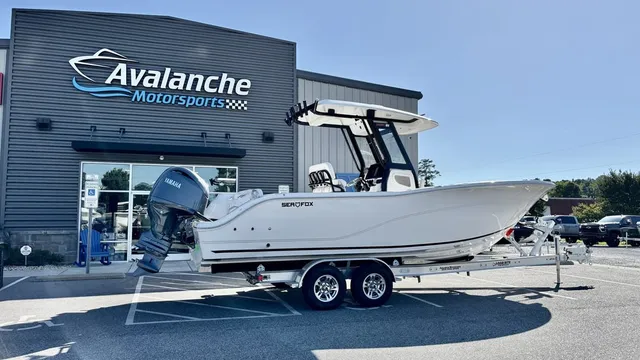
Carolina Flare refers to the outward angle of the hull topsides — the hull sides above the waterline flare outward as they rise toward the gunwale. When a wave strikes the hull, the flare deflects water and spray outward and downward, away from the cockpit, instead of letting it roll inward over the gunwale.
On a flat day, flare is invisible. On a rough day running into a 2–3 foot chop in Pamlico Sound, or pushing through the inlet swells at Oregon Inlet, Carolina Flare is the difference between a dry cockpit and a cockpit full of spray. For anglers who fish in real conditions, this isn't a small thing.
Carolina Flare also contributes to secondary stability — when the boat heels, the flared topside contacts the water and provides resistance. This makes Sea Fox hulls feel planted and stable at rest on anchor, which matters when you're drifting for red drum or waiting on a bite offshore.
What Is Deadrise and Why Does It Matter?
Deadrise is the angle of the hull bottom relative to horizontal, measured at the transom. A flat bottom has 0° deadrise. A sharper V has higher deadrise. Deadrise is the primary determinant of offshore ride quality — higher deadrise means the hull cuts through waves rather than pounding on top of them.
The tradeoff: higher deadrise improves offshore ride in head seas but reduces stability at rest. Lower deadrise boats feel more stable at anchor but pound harder in chop. Sea Fox tunes deadrise to the mission of each model.
At anchor in the Gulf Stream with lines out, you want a hull that doesn't rock. Running back to the inlet in a 3-foot chop, you want a hull that cuts. Sea Fox hits both with model-specific deadrise tuning across the lineup.
How Carolina Flare Deep-V Performs in NC Conditions
Eastern NC coastal waters present a specific challenge: short-period chop. The Gulf Stream is 50–70 miles offshore from Beaufort Inlet and Oregon Inlet. The water between the inlet and the Stream is relatively shallow — Pamlico Sound averages 14 feet, the inner continental shelf breaks at 30–50 feet. Shallow water generates steep, short-period waves that pound flat-bottomed hulls harder than long offshore swells.
Sea Fox's Carolina Flare deep-V geometry was specifically developed for this environment. The deep-V entry slices through steep chop rather than riding over it. The flared topsides keep spray down. The result is a boat that stays drier and more controlled in the conditions Eastern NC anglers actually encounter — not ideal laboratory sea conditions.
At Pamlico Sound, the combination of wind-driven chop, fetch across a large shallow body of water, and frequent powerboat traffic creates conditions that expose hull design flaws quickly. Sea Fox 268 Commander owners regularly run from Washington, NC down the Pamlico River to the Sound and out through Ocracoke Inlet — a route that tests hull design thoroughly.
The 368 Commander runs extended offshore trips where sustained speed in 4–6 foot swells matters. The 23° deadrise on the 368C delivers a noticeably smoother sustained offshore ride than the 18° hulls — a real difference when you're 60 miles out and running back in degrading conditions.
Sea Fox Hull Design vs. Common Competitors
| Feature | Sea Fox | Comparison |
|---|---|---|
| Hull type | Carolina Flare deep-V | Varies: modified-V, stepped, flat |
| Deadrise (typical) | 18–23.5° depending on model | 16–24° — check per model |
| Spray deflection | Carolina Flare topsides | Standard flare or plumb sides |
| Stability at rest | Strong — wide beam + flare | Varies widely |
| Construction | All-composite, zero wood | Varies — some have wood components |
| Warranty | Lifetime Structural Hull Warranty | 10-year to limited lifetime |
What "All-Composite Zero-Wood" Means for Hull Longevity
Hull design is only as good as the materials underneath it. Sea Fox builds every hull with 100% composite construction — no wood in the stringers, transom, deck core, or anywhere in the structural laminate. Wood absorbs water. Composites don't. In a saltwater environment where moisture intrusion is constant, eliminating wood from the structure eliminates the most common cause of long-term hull degradation.
Closed-cell foam-filled stringers provide structural rigidity without the rot risk. The Penske foam-core transom with glassed-in aluminum motor plate handles the mechanical loads of outboard engines without the flex or moisture absorption of a wood-cored transom. High-density foam-cored deck panels are chemically bonded to the hull — no mechanical fasteners through the deck that could leak.
The hull design and construction system work together. A well-designed hull geometry in poor-quality materials will degrade. Sea Fox's Carolina Flare deep-V hull is built in materials matched to the offshore environment it's designed for.
Which Sea Fox Hull Is Right for You?
- You fish Pamlico Sound, nearshore, and occasional offshore runs
- Budget is $80,000–$95,000
- You want a single or light twin that trailers and docks easily
- Crew size is typically 2–4 people
We've watched Sea Fox hulls go in and out of Eastern NC inlets for years. Carolina Flare deep-V isn't a slogan we put on brochures — it's something we see perform in real conditions. The 268 Commander running back from the Stream in a building chop. The 228 Commander duck-hunting in Pamlico Sound in November. The 328 Commander 70 miles offshore. The hull design earns its reputation on every run. That's why we're the #1 Sea Fox dealer in the USA — the boats back it up.
Frequently Asked Questions: Sea Fox Hull Design
What is Carolina Flare on a Sea Fox boat?
Carolina Flare is the outward angle of the hull topsides above the waterline. When a wave strikes the hull, the flare deflects spray outward and downward — away from the cockpit — rather than letting it roll inward. It's a hull design feature developed in the Carolina boat-building tradition for Southeast offshore and coastal fishing conditions. Sea Fox uses Carolina Flare on every center console model.
What deadrise does the Sea Fox 268 Commander have?
The Sea Fox 268 Commander has a 20° deadrise — one of the sharpest entry angles in the 26-foot center console class. Combined with the Carolina Flare topsides, it delivers a dry, controlled ride in the short-period chop typical of Eastern NC coastal waters, Gulf Stream runs, and inlet passages.
What deadrise does the Sea Fox 228 Commander have?
The Sea Fox 228 Commander has an 18° deadrise. This balances offshore capability with stability and is well-suited to Pamlico Sound, nearshore NC fishing, and moderate offshore conditions. For dedicated Gulf Stream runs requiring maximum chop-cutting ability, the 268 Commander's 20° deadrise is the stronger performer.
Is a higher deadrise always better?
Not necessarily — it depends on your fishing environment. Higher deadrise (20°+) cuts through steep offshore chop and swells more smoothly, but reduces stability at rest. Lower deadrise (16–18°) is more stable at anchor in calm conditions. Sea Fox tunes deadrise by model to match the mission: 18° on the 228C for versatile inshore/nearshore use, 20° on the 268C for offshore-focused performance, 22.5° on the 328 Commander for extended Gulf Stream trips.
Does Sea Fox have a stepped hull?
No — Sea Fox uses a conventional deep-V hull with Carolina Flare, not a stepped hull. Stepped hulls reduce wetted surface area at speed for efficiency gains, but are more complex to build and can behave unpredictably in following seas. Sea Fox's proven deep-V geometry prioritizes stability, predictability, and ride quality across a wide range of conditions — which is the right priority for offshore fishing boats.
How does Sea Fox hull design compare to Grady-White?
Both Sea Fox and Grady-White use deep-V hull designs optimized for offshore fishing. Grady-White typically runs 20–23° deadrise on their offshore models; Sea Fox runs 18–22.5° depending on model. Both use all-composite zero-wood construction and lifetime hull warranties. The primary difference is price: Sea Fox delivers comparable offshore hull engineering at a significantly lower price point. Grady-White carries more brand prestige; Sea Fox carries more boat per dollar.
What is the widest Sea Fox center console?
The Sea Fox 368 Commander has an 11'0" beam — the widest hull in the lineup. The 328 Commander runs 10'6". The 288 Traveler is 9'8" and the 288 Commander is 9'6". Beam determines cockpit width and stability at rest — wider beam is a genuine advantage for fishing with a full crew offshore.
Can I see Sea Fox hull construction in person at Avalanche Motorsports?
Yes — Avalanche Motorsports is located at 2287 W. 5th St., Washington, NC 27889. We are the #1 Sea Fox dealer in the USA with the full lineup in stock. We can walk you through hull construction details and get you on the water for a sea trial. Call (252) 946-0920 to schedule.
