
Sea Fox Build Process: How Every Hull Is Made in Conway, SC
Sea Fox builds every boat in Conway, South Carolina using a hand-laid fiberglass process with isothalic gelcoat, vinyl ester barrier coat, and 100% composite construction — no wood anywhere in the structure. Understanding how a Sea Fox is built is one of the best ways to understand why the boats hold up the way they do over 10, 15, and 20 years of saltwater use.
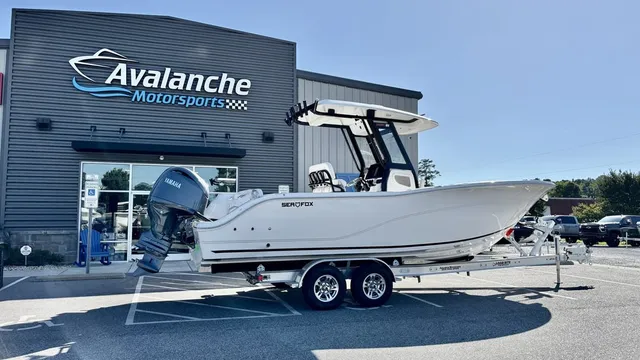 Sea Fox 268 Commander at Avalanche Motorsports Washington NC" class="mp-hero-img" loading="eager" width="620">
Step 1: The Mold — Where the Hull Shape Starts
Every Sea Fox hull starts in a mold — a precision-built negative of the final hull shape. The mold determines everything about the hull geometry: the deadrise angle, the Carolina Flare profile, the running surface, and the overall lines of the boat. Sea Fox builds and maintains their own molds in Conway, SC, which gives them control over hull design changes and quality consistency.
Mold quality is the foundation of production fiberglass boat quality. A well-maintained mold produces a fair, consistent hull surface with tight dimensional tolerances. Sea Fox's molds are built to produce the Carolina Flare deep-V geometry that defines their offshore performance characteristics.
Before any material goes into the mold, it's cleaned and waxed with mold release. This ensures the finished hull releases cleanly without damage to the gelcoat surface — which is the outer face of the finished hull.
Step 2: Isothalic Gelcoat — The Outer Shell
The first material into the mold becomes the outermost layer of the finished hull — the surface you see and touch. Sea Fox sprays isothalic gelcoat into the mold before any fiberglass goes in. Isothalic gelcoat is a premium polyester resin with higher moisture resistance than standard orthalic gelcoat used by most production builders at comparable price points.
The gelcoat layer is typically 18–25 mils thick — thin enough to be flexible, thick enough to provide UV protection, abrasion resistance, and the primary moisture barrier. Color is integrated into the gelcoat, not painted on — which is why well-maintained gelcoat lasts decades without the peeling and fading you see on painted finishes.
Isothalic gelcoat's tighter molecular structure slows the rate at which water vapor penetrates the outer surface. In a saltwater environment where the hull is constantly exposed to moisture, this difference compounds over years and is the primary reason osmotic blistering is rare on properly spec'd fiberglass boats.
Step 3: Vinyl Ester Barrier Coat — The Second Line of Defense
Directly behind the gelcoat, Sea Fox applies a vinyl ester resin barrier coat before any structural fiberglass laminate goes in. Vinyl ester resin is significantly more moisture-resistant than polyester resin — it's the same type of resin used in chemical storage tanks where moisture intrusion is unacceptable.
This barrier coat layer creates a near-impermeable membrane between the gelcoat and the structural laminate. Even if water vapor slowly works through the isothalic gelcoat over many years, the vinyl ester barrier coat stops it before it reaches the laminate and triggers osmotic blistering.
Most production fiberglass boat builders at Sea Fox's price point do not include a vinyl ester barrier coat. It adds cost and time to the build process. Sea Fox includes it on every hull — which is why they can back it with a Lifetime Limited Hull Warranty.
Step 4: Hand-Laid Fiberglass Laminate
After the gelcoat and barrier coat cure, the structural laminate begins. Sea Fox uses a hand-laid process — woven fiberglass cloth is cut, positioned, and wet out with resin by hand, layer by layer. Hand-laid construction allows for strategic placement of heavier reinforcement in high-stress areas like the transom, stringers, and hull-to-deck joint.
Sea Fox specifies 36/10 oz woven fiberglass knit for their hull laminate — a combination of heavy and fine weave that provides both structural strength and a fair, consistent surface. The laminate is built up in multiple layers, with each layer allowed to partially cure before the next is applied to ensure proper adhesion between plies.
The hand-laid process is more labor-intensive than chopper gun or resin-infusion methods, but gives the builder more control over laminate thickness and fiber orientation. Critical structural areas — the keel, chines, transom, and stringer attachment points — receive additional reinforcement layers.
Once the hull laminate is complete, it's allowed to fully cure in a temperature-controlled environment before being pulled from the mold. Post-cure processing removes any mold release residue and prepares the hull for interior component installation.
Step 5: Zero-Wood Structural Components
This is where Sea Fox differs most significantly from many competitors: no wood is used anywhere in the structural components. Not in the stringers, not in the transom, not in the deck core, not anywhere.
Stringers: Closed-cell foam-filled fiberglass stringers run the length of the hull, bonded to the hull laminate. Closed-cell foam cannot absorb water — even if moisture reaches the stringer cavity, it doesn't wick or spread. The fiberglass skin over the foam provides structural rigidity without the rot risk of wood.
Transom: Sea Fox uses a Penske foam-core transom with a glassed-in aluminum motor plate. Penske board is a high-density composite panel used in demanding structural applications. It doesn't absorb moisture. The aluminum motor plate distributes outboard engine loads without stress concentrations. A wood transom absorbs water over time, especially at fastener penetrations — eventually softening and losing structural integrity. Sea Fox's composite transom doesn't have that failure mode.
Deck: High-density foam-cored fiberglass panels, chemically bonded to the hull — no mechanical fasteners through the deck core that could leak. The foam core reduces deck weight while maintaining rigidity and provides additional flotation.
Result: Every structural component that could rot if exposed to moisture is built from materials that physically cannot rot. The Lifetime Structural Hull Warranty exists because Sea Fox has eliminated the primary failure mechanisms of production fiberglass boats.
Step 6: Hull-to-Deck Joint and Final Assembly
The hull and deck are joined with a fiberglass-tabbed joint and sealed with marine-grade sealant. The hull-to-deck joint is one of the most common water intrusion points on production fiberglass boats — Sea Fox's joint design and sealing process is covered under the structural hull warranty.
Final assembly includes installation of helm console, wiring harness, plumbing, livewells, rod holders, fuel tank, and all hardware. Engines are rigged and tested at Avalanche Motorsports — not shipped blind to the customer. Every Sea Fox that leaves our lot gets a pre-delivery inspection and water test.
We've been selling Sea Fox boats for years and we service them after the sale. The build quality we describe here isn't marketing copy — it shows up in the boats that come back through our service department. Rotted transoms, delaminated decks, and osmotic blistering are what we fix on other brands. On Sea Fox, we do routine maintenance checklist. That difference is entirely attributable to the build process. When we say zero wood and vinyl ester barrier coat, those aren't buzzwords — they're the reason the Lifetime Structural Hull Warranty actually means something.
Frequently Asked Questions: Sea Fox Build Process
Where are Sea Fox boats built?
Sea Fox boats are built in Conway, South Carolina — the same city as Tidewater Boats, making Conway one of the most concentrated boat-building communities in the Southeast US. Sea Fox has built in Conway for decades and maintains full manufacturing operations there.
Does Sea Fox use hand-laid or chopper gun fiberglass?
Sea Fox uses a hand-laid fiberglass laminate process. Hand-laid construction allows for strategic placement of woven fiberglass cloth in specific orientations and thicknesses, with additional reinforcement in high-stress structural areas. This is more labor-intensive than chopper gun construction but provides greater control over the laminate schedule.
Does Sea Fox use any wood in their boats?
No — Sea Fox uses zero wood anywhere in the structural components. Not in the stringers, not in the transom, not in the deck core. Stringers are closed-cell foam-filled fiberglass. The transom is Penske foam-core composite with a glassed-in aluminum motor plate. The deck is high-density foam-cored fiberglass chemically bonded to the hull. This eliminates the most common long-term failure mode in production fiberglass boats: moisture intrusion into wood components.
What fiberglass does Sea Fox use?
Sea Fox specifies 36/10 oz woven fiberglass knit for their hull laminate — a combination of heavy and fine weave that provides structural strength, fair surface finish, and controlled resin-to-glass ratios. The laminate is hand-laid in multiple layers with additional reinforcement at high-stress structural areas.
What makes Sea Fox construction better than competitors?
Three things set Sea Fox apart from most production builders at their price point: (1) Isothalic gelcoat instead of standard orthalic — better moisture resistance. (2) Vinyl ester barrier coat behind the gelcoat — a second layer of moisture protection most builders skip. (3) 100% zero-wood construction — closed-cell foam stringers, Penske foam-core transom, foam-cored deck. Together these eliminate the primary failure modes of production fiberglass boats: osmotic blistering, rotted transoms, and delaminated decks.
What is the Sea Fox hull warranty?
Sea Fox offers a Limited Lifetime Structural Hull Warranty for the original owner, plus a 5-year blister warranty. The structural warranty covers the integrity of the hull laminate, transom, and structural components. The blister warranty specifically covers osmotic blistering. The warranty is transferable to a second owner within a 14-day window at resale — supporting used-market value.
Can I tour the Sea Fox factory?
Sea Fox does not offer public factory tours. However, Avalanche Motorsports in Washington, NC can walk you through the construction details of any model in person — hull cross-sections, construction specs, and the warranty documentation. Call (252) 946-0920 to schedule a visit.
