
Sea Fox Isothalic Gelcoat: What It Is and Why It Matters for Offshore Boats
When Sea Fox says isothalic gelcoat, they mean the highest-grade marine gelcoat available — the same spec used on offshore performance boats costing twice as much. Most production boats use standard orthalic gelcoat. Sea Fox doesn't. Here's the difference, why it matters for saltwater fishing in North Carolina, and what it means for your hull over 10–20 years.
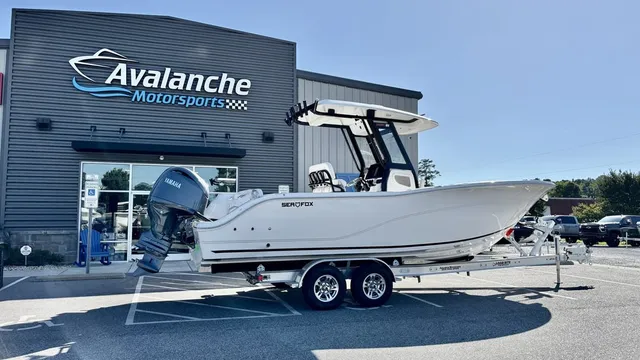 268 Commander showing hull construction at Avalanche Motorsports Washington NC" class="mp-hero-img" loading="eager" width="620">
What Is Isothalic Gelcoat?
Gelcoat is the outermost layer of a fiberglass boat hull — the part you see and touch. It's not paint. It's a pigmented polyester resin that's applied to the mold first, before the fiberglass laminate is laid in behind it. The gelcoat is what protects the laminate from UV, abrasion, and most importantly: water absorption.
There are two main types of gelcoat resin used in marine production: orthalic (standard) and isothalic (premium). The chemistry difference is in the acid used to create the polyester: orthophthalic acid vs. isophthalic acid. Isothalic resins have tighter molecular cross-linking — they are less permeable to water molecules.
In plain terms: isothalic gelcoat lets less water through. For a saltwater fishing boat that lives in the water and gets trailered in and out of inlets, that difference compounds over years. Less water penetration means less risk of osmotic blistering, longer gelcoat integrity, and a hull that stays structurally sound decade after decade.
Most production boats at the $70,000–$120,000 price point use orthalic gelcoat. It's cheaper and faster to work with in production. Sea Fox uses isothalic gelcoat across their entire lineup — from the 228 Commander up to the 368 Commander — at no additional cost to the buyer.
Isothalic Gelcoat + Vinyl Ester Barrier Coat: The Two-Layer System
Sea Fox doesn't stop at isothalic gelcoat. Behind the gelcoat, they apply a vinyl ester barrier coat to the inner surface of the gelcoat before the fiberglass laminate is laid in. This creates a two-layer moisture defense system.
Vinyl ester resin is significantly more water-resistant than either orthalic or isothalic polyester. It's the same resin used in chemical storage tanks and marine applications where moisture intrusion would be catastrophic. As a barrier coat applied directly behind the gelcoat, it creates a near-impermeable membrane between the gelcoat layer and the structural laminate.
The result: even if water vapor slowly works through the isothalic gelcoat over many years, the vinyl ester barrier coat stops it before it reaches the laminate. Osmotic blisters form when water molecules penetrate the gelcoat and react with water-soluble materials in the laminate — creating internal pressure that pushes outward as bubbles. With both layers in place, that process effectively cannot happen.
What Are Osmotic Blisters and Why Do They Happen?
Osmotic blistering is the #1 long-term hull quality issue in production fiberglass boats. It typically appears as round, bubble-like deformations in the gelcoat, usually below the waterline, after 5–15 years of use. If you've ever bought or surveyed a used fiberglass boat, you've probably seen them.
Osmosis occurs when water molecules (very small) pass through the gelcoat layer and encounter water-soluble compounds in the laminate or between laminate layers. These compounds dissolve in the trapped water, creating a fluid with a different concentration than the water outside. Osmotic pressure drives more water inward to equalize the concentration — and eventually the internal pressure exceeds the gelcoat's tensile strength, pushing outward as a blister.
Once blisters form, repair requires grinding down the gelcoat, drying the laminate (which can take months), applying epoxy barrier coat, and refinishing. It's a $3,000–$15,000+ repair depending on severity — and it affects resale value significantly before repairs.
Isothalic gelcoat dramatically reduces the rate at which water molecules penetrate the gelcoat. The vinyl ester barrier coat behind it creates a second line of defense. Sea Fox's two-layer system is specifically designed to prevent osmotic blistering over the life of the hull — which is why they can offer a 5-year blister warranty.
Isothalic vs. Orthalic: Side-by-Side
| Feature | Sea Fox | Comparison |
|---|---|---|
| Resin type | Isophthalic polyester | Orthophthalic polyester |
| Water permeability | Low — tighter molecular structure | Higher — standard production spec |
| Blister resistance | Significantly better | Adequate for protected waters |
| UV stability | Better gloss retention long-term | Standard |
| Cost | Higher — premium raw material | Lower — most common production choice |
| Used by Sea Fox | ✅ Every hull, every model | ❌ Not used |
| Typical price point | Premium & performance builders | Entry to mid-range production |
Why This Matters More in North Carolina Waters
Eastern NC boats spend a lot of time in brackish and saltwater environments — Pamlico Sound, the Neuse River, Oregon Inlet, Beaufort Inlet. Saltwater is more osmotically aggressive than freshwater; the salt ions create steeper concentration gradients that accelerate the osmotic process in a poorly sealed hull.
Boats that trailer frequently between salt and fresh water experience thermal cycling that can micro-crack standard gelcoat over time, creating additional entry points for moisture. Sea Fox's isothalic gelcoat has better thermal stability and flexibility than orthalic, reducing micro-crack propagation.
At Avalanche Motorsports in Washington, NC, we see the long-term results of construction quality on the boats that come through our service department. The correlation between gelcoat specification and long-term hull condition is real and observable. It's one of the reasons we carry Sea Fox — the construction spec matches the environment our customers fish in.
Who Should Care About Isothalic Gelcoat?
- Fish saltwater regularly — Pamlico Sound, inlets, offshore
- Plan to keep the boat 10+ years
- Store in the water for extended periods
- Want strong resale value backed by documented construction quality
- Are comparing Sea Fox to a competitor and want to know what's different
- Fish freshwater only — osmotic pressure is much lower
- Plan to sell within 3–5 years before blistering typically appears
- Store on a dry-stack or trailer 100% of the time
We've been selling and servicing Sea Fox boats in Washington, NC for years. The isothalic gelcoat and vinyl ester barrier coat aren't marketing — they're the reason we're confident recommending Sea Fox to customers who plan to keep their boat for a decade or more. When a customer comes back 10 years later and the hull still looks right, that's not luck. It's spec. The Lifetime hull warranty and 5-year blister warranty are Sea Fox putting that confidence in writing.
Frequently Asked Questions: Sea Fox Isothalic Gelcoat
What is isothalic gelcoat?
Isothalic gelcoat is a premium-grade polyester resin used as the outermost layer of a fiberglass boat hull. It uses isophthalic acid in its formulation, which creates a tighter molecular structure and lower water permeability than standard orthalic (orthophthalic) gelcoat. Sea Fox uses isothalic gelcoat on every hull they build.
Does Sea Fox use isothalic gelcoat on all models?
Yes — Sea Fox specifies isothalic gelcoat across their entire lineup, from the 228 Commander through the 368 Commander. It's not a premium-tier option. It's the standard construction spec on every Sea Fox hull.
What is the difference between isothalic and orthalic gelcoat?
Both are polyester resin gelcoats, but isothalic uses isophthalic acid in its formulation, which produces a tighter molecular cross-link structure. The result is lower water vapor permeability — water molecules pass through isothalic gelcoat more slowly. This reduces the risk of osmotic blistering, improves UV stability, and maintains gloss longer. Most production boats use standard orthalic gelcoat because it's cheaper and easier to work with.
What is a vinyl ester barrier coat?
Vinyl ester resin is a step above polyester — it's the same type of resin used in chemical storage tanks for its moisture resistance. Sea Fox applies vinyl ester resin as a barrier coat directly behind the isothalic gelcoat, before the fiberglass laminate is laid in. This creates a second moisture-resistant layer between the gelcoat and the structural laminate — significantly reducing the risk of osmotic blistering.
What causes osmotic blistering in fiberglass boats?
Osmotic blistering occurs when water molecules penetrate the gelcoat and encounter water-soluble compounds in the laminate. These compounds dissolve in the trapped moisture, creating an internal fluid with higher concentration than the surrounding water. Osmotic pressure drives more water inward, eventually building enough pressure to push the gelcoat outward as a bubble or blister. It typically appears below the waterline after 5–15 years of use. Isothalic gelcoat and vinyl ester barrier coat significantly reduce the rate of water penetration that triggers this process.
Does Sea Fox have a blister warranty?
Yes — Sea Fox offers a 5-year blister warranty in addition to their Lifetime Structural Hull Warranty. The blister warranty specifically covers osmotic blistering in the hull gelcoat. This warranty exists because Sea Fox is confident in their two-layer construction system. Ask Avalanche Motorsports for the full warranty terms when you visit.
How does Sea Fox gelcoat compare to Grady-White or other premium brands?
Grady-White also uses isothalic gelcoat — it's considered the offshore performance standard. Sea Fox matches Grady-White's gelcoat specification at a significantly lower price point. Most mid-range production brands at similar price points to Sea Fox use standard orthalic gelcoat. Sea Fox's use of isothalic gelcoat plus vinyl ester barrier coat at their price point is genuinely unusual and a real differentiator.
Can I see Sea Fox boats at Avalanche Motorsports?
Yes — Avalanche Motorsports is at 2287 W. 5th St., Washington, NC 27889. We are the #1 Sea Fox dealer in the USA. Call (252) 946-0920 to schedule a visit or sea trial. We can walk you through the construction details on any model in person.
